
Can 45 watts cool 1,300 sq ft? We ran the numbers
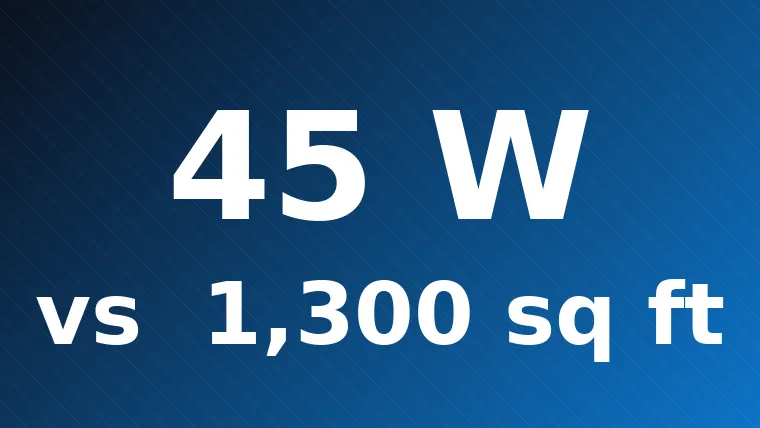
A personal-cooler offer page we archived in July said its 45 watts could cool spaces “up to 1,300 sq ft”. That is a checkable claim, so we checked it — in public, with the arithmetic shown. Spoiler: the number fails as room cooling and survives as something humbler and still useful.
The claim, stated fairly
45 W input, evaporative technology (water + ice reservoir, no hose), coverage “up to 1,300 sq ft / 1,000 sq ft” depending on the section of the page. The device behind that claim has since been withdrawn from sale; this page keeps the arithmetic, because the same coverage claim is made across the category.
Step 1 — what a 1,300 sq ft space gains in heat
Standard sizing guidance puts a 1,300 sq ft open area at roughly 24,000–30,000 BTU/h of required cooling (about 7–9 kW of heat removal) once you include ceilings, occupants and a normal sun load — you can reproduce this in our BTU calculator. Compressor systems achieving that draw multiple kilowatts of electricity.
Step 2 — the very best 45 W of evaporation can do
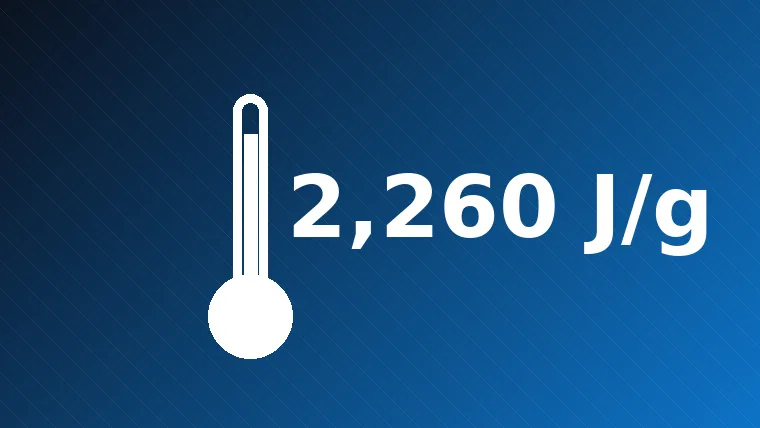
Evaporative cooling’s currency is water: every gram evaporated absorbs about 2,260 joules. A small unit’s realistic evaporation rate (limited by airflow and pad area) yields on the order of a few hundred watts of heat absorption under ideal dry conditions — genuinely more cooling than its electrical input, which is evaporation’s magic trick, but still 1–3% of the load computed in step 1. And that cooling arrives as one directed, moist airstream, not as distributed room conditioning.
Step 3 — what “coverage” can honestly mean
Air movement can be felt far away in an open space; wind-chill on skin is real comfort. Read charitably, “1,300 sq ft” describes where the breeze reaches, not what gets cooled. Read as air conditioning, it is off by roughly two orders of magnitude — the same test that sinks most of the listings in our mini-AC honesty check.
Verdict
Claim: fails as room cooling; plausible as breeze reach. The device behind it has since been withdrawn from sale, but the shape of the claim outlived it: every cooler in this category runs on tens of watts and describes an area in the hundreds or thousands of square feet. Judged as a personal cooler — cold-feeling outlet air on water and ice, running costs a compressor cannot approach — the class is genuinely useful. Judged as air conditioning, the arithmetic above is what happens every time.
Frequently asked questions
Is the 1,300 sq ft claim a lie?
It is best read as “air from this unit can be felt in a large open space”, not “this unit air-conditions 1,300 sq ft”. As a room-cooling claim it fails arithmetic by two orders of magnitude; as a personal-zone claim it is defensible.
How many watts would that room actually need?
A 1,300 sq ft open space typically calls for roughly 24,000+ BTU/h of refrigerated cooling — several kilowatts of electrical input — before sun, occupancy and insulation corrections. Run your own room in the BTU calculator.
Recommended
Evaporative cooling physics: the real numbers behind the breeze
Evaporative cooling physics without hand-waving: latent heat of 2,260 J/g, wet-bulb limits by humidity, why ice helps, and a table you can shop with.
Read More →
Froza review (2026): five watts, and what they can do
Froza review: the brand publishes 5 V / 1.0 A — about five watts. What that can actually cool, and why the checkout's 18 °C claim cannot be reached.
Read More →
Reader comments
Comments are moderated before appearing publicly. Your email is never displayed.