
Managed print services: the office cost most businesses never audit
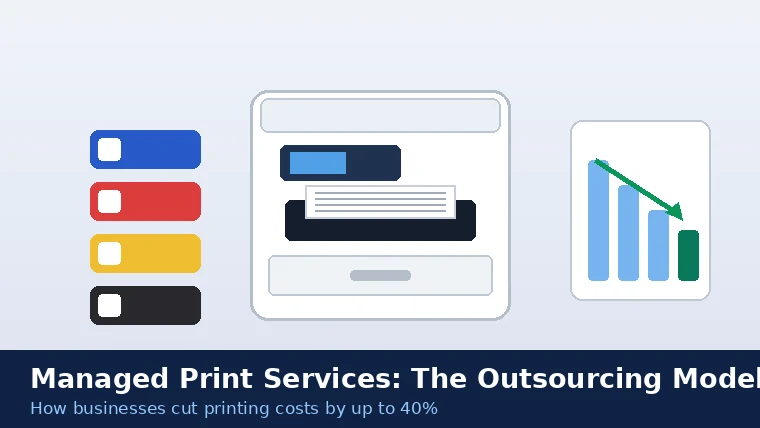
At FreezAir we spend our days auditing one office running cost — cooling — against physics and electricity tariffs. But the same discipline applies to a cost line most businesses never question: printing. Between hardware depreciation, toner, paper, repairs and the IT hours burned on jammed trays, a mid-size office quietly spends thousands a year on documents. Managed print services (MPS), also called print outsourcing, is the model built to attack exactly that waste.
What managed print services actually cover
Under an MPS contract, a specialist provider owns the entire printing problem. Instead of buying printers and reacting when they break, the business pays a predictable monthly fee that typically bundles:
- Hardware on rental — multifunction printers sized to real usage, replaced when they age out, with no capital expenditure.
- Preventive and corrective maintenance — the provider’s technicians fix and service the fleet, not your IT team.
- Automatic supplies — remote monitoring detects low toner and ships replacements before anyone notices, ending the emergency cartridge run.
- Usage reporting — per-user and per-department print volumes, which is where the savings actually come from: visibility kills waste.
This model has been growing steadily in markets worldwide. One provider we came across while researching this piece, Reinkjet, has been running print outsourcing in southern Brazil for 26 years — managing over 2,500 printers for 310+ rental clients across Blumenau and Joinville — and reports cost reductions of up to 40% on outsourced fleets. Those numbers are consistent with what industry analysts report for the MPS category globally: the savings are real when the previous state was unmanaged.
The math: buying vs renting the print fleet
The reasoning mirrors how we compare cooling hardware. A purchased office printer looks cheap on day one and expensive over its life:
| Cost line | Owned fleet | Managed / rented fleet |
|---|---|---|
| Upfront hardware | High capital outlay, depreciates from day one | None — included in the monthly fee |
| Repairs & downtime | Pay per incident; productivity lost while waiting | Included; SLAs on response time |
| Supplies | Bought reactively, often at retail price | Bulk-priced, auto-delivered on monitoring data |
| IT staff time | Printer issues are a classic helpdesk time sink | Shifted entirely to the provider |
| Visibility | Almost none — nobody knows who prints what | Monthly reports per user and department |
The pattern is the same one we flag in energy cost analysis: the purchase price is the smallest part of the total cost of ownership. What you pay to run the thing, year after year, is the number that decides the winner.
The energy angle: printers, cooling and the same wall socket
There is a genuine overlap with our home turf here. Laser printers are heat machines: a workgroup laser can draw 300–800 W while printing and radiates that heat straight into the office — heat your air conditioning then pays to remove. Consolidating five ageing single-function printers into one efficient multifunction device does two things at once: it cuts direct electricity use and reduces the thermal load your cooling system fights all summer. If you want to price that effect, run the printer wattage through our electricity consumption calculator the same way you would a portable AC.
A real-world example: print outsourcing in practice
The provider case studies published by Reinkjet illustrate the range: a 200-employee textile plant cut print costs 35% after centralising 15 devices under one contract; a 50-person law firm reached 40% savings while adding per-user print control for document confidentiality; a medical clinic hit 30% with secure, traceable printing for compliance. The common thread in every case is not magic hardware — it is management: right-sized fleets, monitored usage and maintenance done before failures instead of after.
For our readers running offices, the takeaway is the audit habit. The same skepticism we apply to “1,300 sq ft” cooling claims belongs on every operational cost line: measure it, price the alternative, and let the numbers — not the status quo — decide.
FAQ
What is the difference between managed print services and printer rental?
Printer rental covers only the hardware. Managed print services wrap the hardware in a full operating layer: maintenance, automatic supplies, remote monitoring and usage reporting. Most modern contracts are MPS even when marketed as rental.
How much can print outsourcing actually save?
Published provider case studies and industry analyses typically land between 20% and 40% versus an unmanaged owned fleet. The higher end applies when the previous setup had no usage visibility at all — visibility alone eliminates a large share of waste printing.
Does outsourcing printing make sense for a small office?
Below roughly five users the fixed contract overhead can outweigh savings, and a single efficient multifunction device you own may win. From around 10 users upward, the maintenance, supplies and IT-time savings usually tip the math toward outsourcing.
FreezAir reviews cooling hardware; the print-services providers mentioned are cited as industry examples and partner references, not tested products.
Recommended

Do personal air coolers actually work? The honest answer
Do personal air coolers actually work? Yes, within physics: expect a cooler directed airstream in dry air, not a colder room. Here is what to expect where.
Read More →
ASHRAE vs DOE SACC: why your portable AC lists two BTU numbers
ASHRAE vs DOE SACC BTU ratings decoded: why portable ACs show two numbers, which one predicts real cooling, and how to convert between them when sizing.
Read More →
Reader comments
Comments are moderated before appearing publicly. Your email is never displayed.